

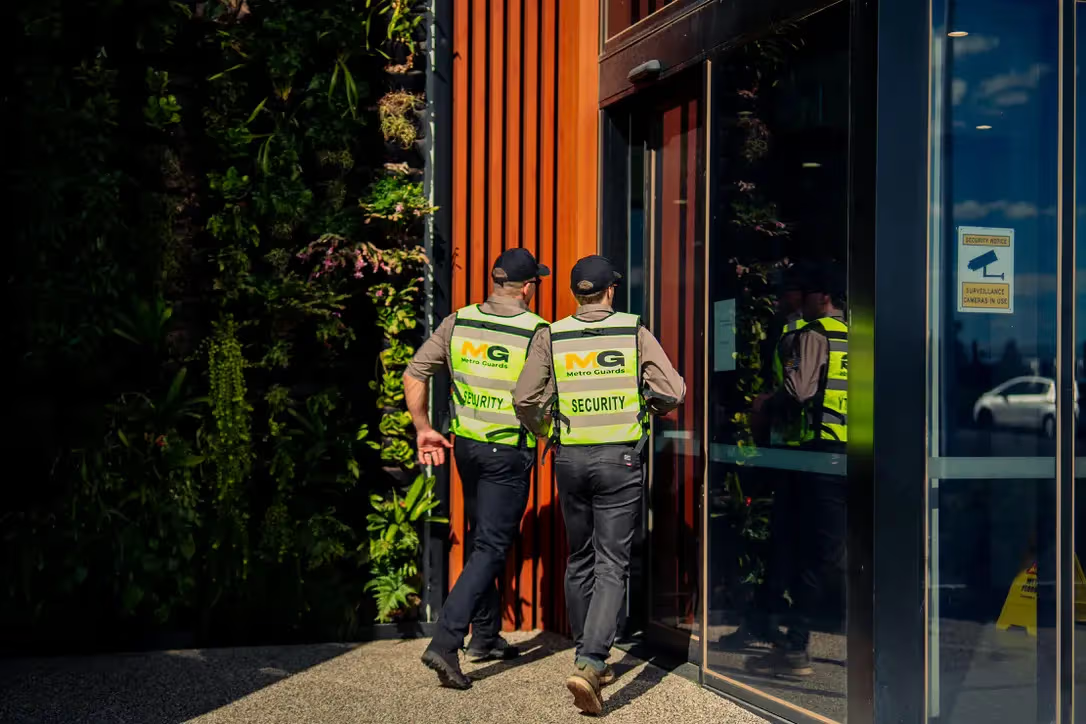
An ISO-certified security company has passed an independent, third-party audit confirming its documented quality and safety systems meet an international standard, typically ISO 9001.
A non-certified company operates without that external check, meaning its training records, incident handling, and management processes are never verified by anyone outside the business.
That distinction sounds small on paper. In practice, it changes how a security provider is run day to day, and it's one of the clearest signals available when comparing options in a crowded market.
What ISO Certification Actually Means
ISO stands for the International Organization for Standardization, the body that writes globally recognised standards for how organisations manage quality, safety, and risk.
A security company doesn't get to call itself "ISO certified" by saying so. It has to build a documented management system, then have that system audited by an accredited, independent certification body before the certificate is issued.
ISO 9001: Quality Management
ISO 9001 is the standard most relevant to a security provider's day-to-day operations. It covers how a company documents its processes, trains staff, handles complaints, and drives continual improvement. For a client, this translates into consistent site procedures rather than a different standard of service depending on which officer is rostered on.
How the Audit Actually Works
Certification bodies in Australia are accredited by JAS-ANZ, the national accreditation authority for conformity assessment. An accredited auditor reviews a security company's policies, interviews staff, checks records, and tests whether the documented system is actually followed on the ground, not just written down.
Certification typically runs for three years, with annual surveillance audits required to keep it active. If a company lets standards slip, the certification lapses.
Nationally, more than 24,000 organisations hold ISO 9001 certification, a figure that puts the standard's uptake in perspective for anyone comparing certified against non-certified operators.
What a Non-Certified Security Company Looks Like
A non-certified provider isn't automatically unsafe or unlicensed. Every individual security officer working in Victoria still has to hold a licence under the Private Security Act 2004 (Vic), and that requirement applies regardless of whether the company itself is ISO certified.
What's missing without certification is the external check on the company's systems. A non-certified business can still write a training manual, a site procedure, or an incident report template, but no independent auditor confirms those documents reflect what actually happens on site, or that they're updated when something goes wrong.
Quality becomes dependent on the judgment of whoever is running the business that week, rather than on a system that's tested against a fixed standard every year.
Why This Gap Is Easy to Miss
Most clients comparing security quotes focus on hourly rates and coverage hours, not management systems. A non-certified provider can look identical to a certified one on a proposal document, with the same uniforms, the same service list, and the same promises around response times.
The difference only becomes visible once something goes wrong. An officer gets rostered incorrectly, a site handover is missed, or an incident report doesn't match what actually happened.
At that point, a certified provider has a documented process to fall back on and an audit trail showing what should have occurred. A non-certified provider often has whatever the manager remembers.
This doesn't mean every non-certified operator runs a loose ship. Many smaller, newer companies are genuinely working toward certification and operate carefully in the meantime. Without the audit, though, there's no independent way for a client to confirm that from the outside.
Noteworthy Differences Between ISO-Certified and Non-Certified Providers
| Area | ISO-Certified Provider | Non-Certified Provider |
|---|---|---|
| Verification | Audited annually by an independent, accredited body | Self-reported, no external check |
| Documentation | Formal QMS covering training, incidents, and complaints | May exist informally or inconsistently |
| Consistency across sites | Standardised procedures across all officers and shifts | Varies by manager or individual officer |
| Accountability | Certification can be suspended for non-compliance | No external body to answer to |
| Tender eligibility | Meets procurement requirements for government and enterprise contracts | Often excluded before proposals are assessed |
Why This is Paramount for the Victorian Security Industry
Melbourne's security market includes everyone from single-operator outfits to large, multi-site providers, and licensing alone doesn't tell a client much about how consistently a company operates.
A security officer's licence confirms they've passed a background check and completed the required training. It says nothing about whether the company deploying them has a documented process for site handovers, incident escalation, or client reporting.
This is where ISO certification, alongside CM3 and ASIAL membership, fills the gap. CM3 is a contractor prequalification system that verifies a company's work health and safety documentation, insurance, and risk management plans before it's approved to operate on client sites, and it's widely used across construction, healthcare, and government procurement in Australia.
ASIAL is the peak body for the security industry in Australia, and corporate membership requires a business to be actively engaged in providing licensed security services and to operate under its code of conduct.
None of these replaces the individual licensing requirements set out in the Private Security Act 2004 (Vic). They sit on top of it, verifying the company layer that licensing alone doesn't touch.
Melbourne CBD sites, in particular, tend to attract a high concentration of security providers competing on price. That competition is good for clients, but it also makes it harder to separate a genuinely well-run operator from one cutting corners on documentation to keep costs down. Certification status is one of the few checks a client can verify independently, rather than relying on a sales pitch.
How to Verify a Security Company's Certifications Before You Hire
A certification badge on a website is a claim rather than proof. Before engaging any provider, it's worth checking:
- The individual officer's licence against Victoria Police's public Register of Licence, Registration and Permit Holders, searchable by name or licence number
- ISO certification by asking for the certificate number and certification body, then confirming it against the certifier's own public register
- ASIAL membership via the ASIAL member directory, which lists corporate members and their membership tier
- CM3 status through the company's CM3 profile, which client organisations can request directly
A provider with nothing to hide will supply this information without hesitation. Hesitation, vague answers, or an unwillingness to provide certificate numbers is itself useful information.
Practical Cost of Skipping This Check
Plenty of small, capable operators run tight businesses without an ISO badge, particularly newer companies still building toward certification. The risk isn't inherent incompetence. It's the absence of an independent check when things go wrong.
If an incident occurs on site and a client later needs to demonstrate they engaged a provider with proper documented systems, for insurance, liability, or tender compliance purposes, a non-certified provider offers nothing to point to beyond its own word.
For businesses in regulated sectors, or anyone tendering for government or corporate contracts, this gap can be enough to disqualify a proposal before it's even reviewed.
How to Choose a Security Company: A Practical Checklist
- Confirm the business licence under the Private Security Act 2004 (Vic) against Victoria Police's public register.
- Ask if they're an ISO certified security company. Request the certificate number and certifying body.
- Check the CM3 status if your site is construction, healthcare, or government-linked.
- Verify ASIAL membership through the ASIAL member directory.
- Look at the local track record across Melbourne CBD and nearby suburbs like Dandenong, Footscray, and Frankston.
- Confirm officer licensing and training, not just company-level certification.
- Request named references from a licensed security company in Melbourne, not vague testimonials.
- Check insurance certificates for public liability and workers' compensation.
- Get response times for your suburb, not a general coverage claim.
Metro Guards: ISO-Certified Security Across Melbourne
Metro Guards has operated as a licensed security company in Melbourne for 15+ years. We hold ISO certification, CM3 certification, and ASIAL membership, and every officer we deploy carries a current Victoria Police licence. Clients have relied on that documented, audited approach to site security.
As an owner-operated business, we're personally accountable for the standards behind every certification we hold.
Looking for an ISO-certified Security Company in Melbourne?
Metro Guards combines ISO-certified quality management, CM3 certification, ASIAL membership, and fully licensed Victoria Police security officers to deliver consistent protection across commercial, industrial, retail, and construction sites throughout Melbourne.
Contact our team today for an obligation-free quote.
Frequently Asked Questions
Does ISO certification mean a security company is more expensive?
Not necessarily. Certification reflects a documented process and independent verification. Rates depend more on the type of service, shift length, and site risk profile.
Is ISO certification a legal requirement for security companies in Victoria?
No. Individual security officers and businesses must hold a licence under the Private Security Act 2004 (Vic), which is a separate, mandatory requirement. ISO certification is voluntary.
How long does ISO certification last?
Three years, with annual surveillance audits required to keep it active. A lapsed audit means a company can lose its certification even mid-cycle.
What's the difference between ISO 9001 and CM3?
ISO 9001 certifies a company's overall quality management system. CM3 is a contractor prequalification system focused specifically on work health and safety documentation, insurance, and risk management.
Can I ask a security company for proof of certification?
Yes. A legitimate provider will supply certificate numbers and the name of the certifying body without hesitation, and these can be checked against the certifier's public register.
Does ASIAL membership mean the same thing as ISO certification?
No. ASIAL is the industry's peak body, and corporate membership confirms a business is engaged in licensed security services under its code of conduct. It doesn't audit a company's internal quality management system the way ISO certification does.