

In 2026, the global hub of Melbourne is no longer just a center for coffee and culture; it is a landscape of rapid technological integration. As businesses from the high-rises of the CBD to the industrial hubs of Truganina and Dandenong evolve, so do the threats they face. The most critical question facing property owners today is no longer "Do I have cameras?" but rather "How smart are my cameras?"
The shift from traditional Closed-Circuit Television (CCTV) to Artificial Intelligence (AI) Surveillance represents the most significant leap in property protection in fifty years. For Melbourne business owners, understanding this divide is the difference between recording a crime and preventing one.
The Legacy of Traditional CCTV: A Reactive History
To understand where we are going, we must look at where we have been. Traditional CCTV has been the backbone of security since the late 20th century. Its primary function is simple: capture light, convert it into an electronic signal, and store it on a hard drive (DVR or NVR).
The Reactive Model
Traditional CCTV is fundamentally reactive. It acts as a digital witness. When a break-in occurs at a retail store on Chapel Street, the owner arrives the next morning to find a shattered window. They then spend hours "scrubbing" through grainy footage to find the moment of impact. By the time the footage is handed to the Victoria Police, the perpetrators are long gone, and the assets have been liquidated.
The False Alarm Dilemma
Standard motion detection in traditional cameras is notoriously unreliable. A spider crawling across the lens, a tree branch swaying in the wind, or a change in shadows can trigger a "motion alert". For a business owner, this leads to "alert fatigue"—eventually, you stop checking your phone at 3 AM because 99% of the notifications are meaningless. In 2026, this lack of precision is a liability.
The Rise of AI Surveillance: Proactive Intelligence in 2026
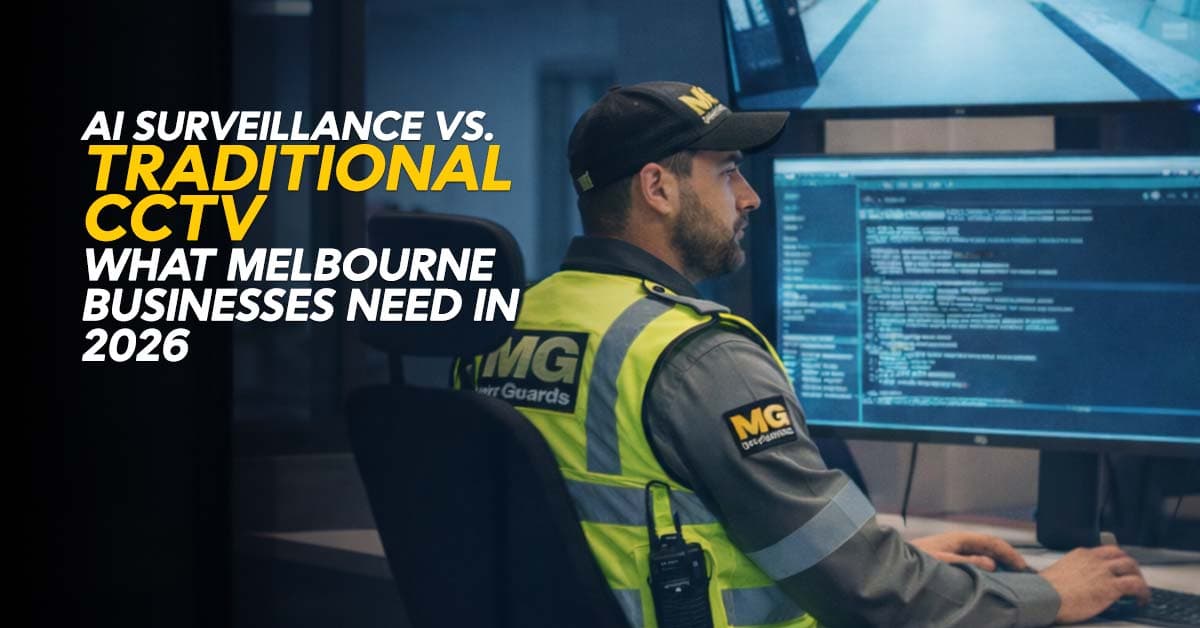
AI Surveillance isn't just a camera; it's a computer with "eyes" that can think. In 2026, these systems utilize Deep Learning and Neural Networks to process visual data in real-time, matching what they see against massive databases of human behavior and objects.
Object Recognition and Classification: The most immediate benefit of AI is its ability to distinguish between a human, a vehicle, and an animal. If a person approaches your perimeter fence at 2 AM, the system identifies them as a "Human Intruder" and sends a high-priority alert.
Predictive Analytics: Advanced algorithms can now detect "loitering" or "casing" behaviors. For example, if a vehicle circles a warehouse three times in an hour, the AI flags this as suspicious.
Behavioral Biometrics: Modern AI can detect sudden changes in movement patterns, such as a person running against the flow of traffic in a shopping center, allowing for immediate intervention.
Melbourne’s "Verified Response" Era
One of the most pressing reasons for the shift to AI in Melbourne is the move toward "Verified Response" policies. Emergency services often require visual verification that a crime is in progress before prioritizing a dispatch.
An AI-integrated system from Metro Guard provides this "Live Verification" instantly. When an intruder is detected, the AI clips the relevant footage and sends it directly to your smartphone or integrated security app. This allows for instant owner-verification when contacting authorities, ensuring your commercial security needs are met with a rapid response.
The Strategic Comparison: At a Glance
Feature | Traditional CCTV | AI Surveillance (2026 Standard) |
Primary Goal | Recording evidence for later use | Preventing the incident in real-time |
Detection Type | Pixel-based motion (inaccurate) | Object-based intelligence (accurate) |
Searchability | Searching by hour/minute | "Smart Search" (e.g., "Find blue van") |
Operational Use | Security only | Security + Business Intelligence |
Beyond Security: AI as a Business Tool
In 2026, a Metro Guard AI installation isn't just a cost center; it’s a source of Business Intelligence (BI).
Retail Optimization: AI cameras generate "heat maps" showing where customers spend the most time.
OH&S Compliance: On construction site security projects, AI can detect if workers are failing to wear helmets or high-vis vests.
Queue Management: In the hospitality sector, AI can alert managers when a queue exceeds five people, optimizing staffing levels in real-time.
The Economic Reality: ROI of AI
Property owners often ask about the price gap. While AI hardware carries a higher upfront cost, the Return on Investment (ROI) is significantly higher:
Reduced Insurance Premiums: Many Victorian insurers offer discounts for properties with 'AI-Driven Proactive Detection'.
Labor Savings: AI can augment security guard services by providing continuous perimeter surveillance, allowing you to deploy human guards to high-touch areas.
Loss Prevention: By stopping a theft before it happens, you save the cost of stolen goods and property damage repairs.
Conclusion: Secure Your Future with Metro Guard
The transition from traditional CCTV to AI Surveillance is a move from looking back to looking forward. In 2026, being reactive is being vulnerable.
At Metro Guard, we specialize in bridging this gap. We don't just sell cameras; we design integrated security ecosystems. Whether you need mobile patrols to respond to AI alerts or a full tech overhaul, we provide the local Melbourne expertise required to navigate the complexities of 2026 security.
The choice is yours: Will you be a witness to a crime, or will you prevent it?